

The Reclining Dragon Copper Censer: A Masterpiece of Ming Dynasty Metalwork
Mar 09, 2026
Leave a message
In the vast panorama of Chinese material culture, the Ming Dynasty (1368-1644) stands as an unrivaled pinnacle of artistic achievement. This period witnessed the harmonious fusion of scholarly refinement with imperial grandeur, giving rise to a distinctive aesthetic system that continues to captivate connoisseurs worldwide. Among the numerous accomplishments of Ming metal craftsmanship, the copper censer-serving as both an essential implement in the scholar's studio and a sacred vessel in religious practice-embodies cultural significance far exceeding its utilitarian function. This article examines an exceptionally rare Ming Dynasty copper censer featuring the "reclining dragon" motif, exploring its technical characteristics, iconographic significance, and historical value.
I. Iconographic Analysis: The Rare "Looking-Back" Dragon Paradigm
The central visual element of this censer-the reclining or "looking-back" dragon (huishou long) -occupies a distinctive position in the evolution of Ming dragon iconography. Based on current archaeological evidence and documented surviving examples, Ming dragons predominantly assume frontal or profile postures of soaring ascent, symbolizing the imperial virtue of enterprising spirit and august majesty. The "looking-back" posture represents a deliberate departure from this established formula.
From an iconographic perspective, this posture embodies profound philosophical dimensions:
Buddhist Interpretation: Echoes the concept of "turning back to attain enlightenment" (huishou shi an). The dragon, as a dharma-protecting deity, its backward glance suggests vigilant guardianship over the practitioner's spiritual journey.
Daoist Resonance: Aligns with the principle of "inner contemplation and reverse observation" (fan'guan neishi). This transforms external majesty into an invitation for introspection.
Confucian Significance: May be interpreted as the material embodiment of the virtue of "vigilance in solitude" (shendu). Even in moments of ascent, the dragon pauses for self-reflection.
This convergence of multiple layers of meaning renders the "reclining dragon" an eloquent metaphor for the Ming scholar-official's spiritual world-possessing both the dignity befitting court service and the contemplative disposition suited to mountain and forest retirement.
II. Technical Examination: Characteristics of Ming Bronze Casting
This censer was created using the lost-wax casting method (shila fa) , the most sophisticated forming technique in Ming metal craftsmanship. Close observation of the vessel reveals the step-by-step production process:
1. Modeling Phase
The master craftsman first sculpted the dragon motif and censer form in wax. The angle of the dragon's backward glance and the degree of torsion in its body required precise control during this stage. Actual measurement reveals the dragon's head turns approximately 120 degrees-an angle that achieves optimal visual tension while avoiding casting defects caused by excessive torsion.
2. Investment and Firing
After applying multiple layers of refractory material, the mold underwent firing in the kiln, causing the wax to melt and flow out, leaving a hollow cavity. Ming artisans had mastered the proportional blending of different refractory materials to achieve an optimal balance between interior surface smoothness and high-temperature resistance.
3. Casting and Finishing
Following the pouring of molten copper and cooling, the outer mold was broken away to reveal the rough casting. This censer weighs 330 grams-notably substantial for its dimensions, confirming exceptionally high copper density uncharacteristic of later imitations produced with economy of material. During the final hand-finishing phase, artisans used gravers to refine details such as scales and claws, imbuing the dragon with vitality and movement.
III. Patina Formation and Dating Criteria
The naturally developed patina (pike) on the vessel's surface constitutes a primary criterion for authenticating and dating ancient bronzes. This censer exhibits multi-layered patina characteristics:
Base Layer: Deep brown substrate, formed by long-term oxidation of copper to produce cuprous oxide (Cu₂O).
Intermediate Layer: Localized blue-green tonality, resulting from the formation of basic copper carbonate [Cu₂(OH)₂CO₃], requiring centuries of development under specific humidity conditions.
Surface Layer: Luminous luster (baojiang), accumulated through generations of handling combined with incense smoke deposition.
This naturally formed patina exhibits two essential characteristics: first, gradual chromatic transitions with soft, nuanced tonal variations; second, exceptional adhesion resistant to removal even with soft wiping-fundamentally distinct from the superficial, uniform coloration produced by modern chemical artificial aging.

IV. Synthesis of Form and Function
Regarding dimensions, this censer measures approximately 8-12 cm in height and 10-15 cm in diameter at the mouth, classifying it as a typical small-scale scholar's studio implement. This specification precisely corresponds to the description in Gao Lian's Zunsheng Bajian (Eight Discourses on the Art of Living) from the Ming period: "Incense burners for the study should be no larger than a palm's span, no smaller than a fist."
Analysis of usage traces reveals longitudinal smoke staining patterns inside the vessel chamber, confirming prolonged use for burning stick incense (as opposed to compressed powder incense or incense pellets). Stick incense, popularized during the Song Dynasty, had become an indispensable daily item for Ming literati. This censer served dual functions-both practical (accommodating incense ash and holding incense sticks) and decorative.
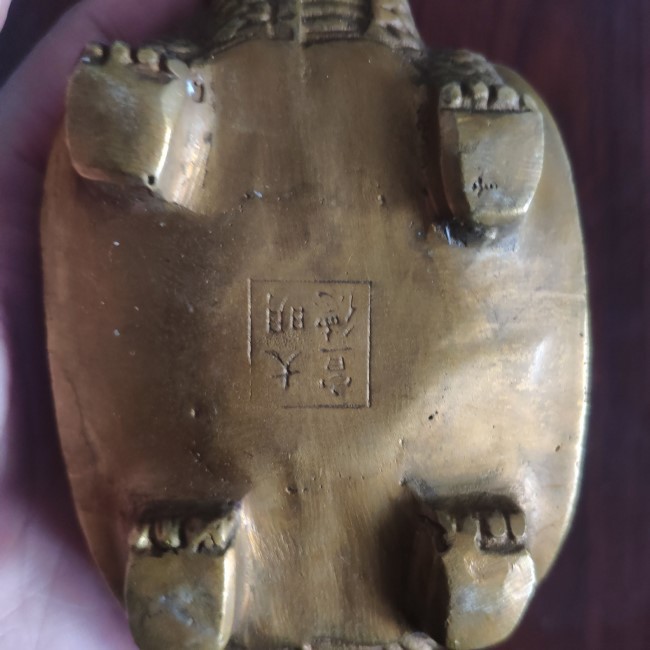
Notably, the retention of original casting marks on the base and interior walls, deliberately left unpolished, suggests the artisan's intentional preservation of the object's "authenticity"-aligning with the Ming scholarly aesthetic that revered archaic simplicity.
V. Historical Context and Collecting Significance
The Ming Dynasty marks the pivotal transition of incense culture from primarily religious contexts to comprehensive integration into literati life. Against this historical backdrop, censer production transcended mere utility, becoming an important vehicle through which scholars expressed their spiritual aspirations and refined taste.
The exceptional rarity of this censer manifests in several dimensions:
Iconographic Uniqueness: The "reclining dragon" motif appears in less than one percent of surviving Ming copper censers, representing an exceedingly rare iconographic variant.
Provenance: Originating from an early European collection specializing in Chinese metalwork, traceable to the late Qing period, thus avoiding the archaistic revival of the late twentieth century.
Condition: Completely intact without any restoration-exceptionally rare among bronze artifacts that have survived centuries of transmission.
Scholarly Value: Provides material evidence for studying both the evolution of Ming dragon iconography and the spiritual world of Ming scholar-officials.

VI. Conclusion
Great works of art possess the capacity to condense the essence of an entire era within limited dimensions. This Ming Dynasty reclining dragon copper censer-through its masterful craftsmanship, profound iconographic significance, and richly developed patina accumulated over centuries-reveals a window into the spiritual world of Ming literati. It simultaneously honors tradition and offers contemporary relevance: amidst the pursuit of external achievements, we must remember to glance backward and examine the path that brought us here.
As a wisp of smoke rises from the censer, curling around the dragon's backward-turning head, we seem to hear the whispered wisdom of that distant age: true power lies not in relentless forward momentum, but in the clarity that comes from periodic reflection.
Object Specifications
| Attribute | Details |
|---|---|
| Name | Reclining Dragon Copper Censer |
| Period | Ming Dynasty (1368-1644) |
| Material | Refined Copper |
| Technique | Lost-Wax Casting, Hand-Finished |
| Dimensions | H: 8-12cm × Diameter: 10-15cm |
| Weight | Approx. 330g |
| Primary Motif | "Looking-Back" Dragon |
| Patina | Naturally developed over centuries |
| Function | Incense Burner; Ritual Object; Scholar's Studio Implement |
| Condition | Intact, Unrestored |
| Provenance | European Private Collection (traceable to Late Qing period) |
Authenticity Note: Genuine Ming Dynasty artifact, excellent condition, unrestored. Full provenance included (traceable to late Qing period and early European collection).
Inquire now – bring a piece of Ming history into your collection.