

Qing Guangxu Blue and White Landscape Plate: A Painted Poem in Cobalt
Jun 05, 2026
Leave a message
The Story
The year is 1895. China has lost the First Sino-Japanese War. The Treaty of Shimonoseki has just been signed. The nation is in mourning, its centuries-old confidence shattered by a modernized neighbor.
But in a porcelain-painting workshop in Jingdezhen, the kilns still burn.
The potter's name is Old Wu. He is sixty-three years old, and he has been painting blue-and-white since he was a boy of twelve. He has lived through three emperors: Xianfeng, Tongzhi, and now Guangxu. He has seen rebellion, war, and the slow crumbling of an empire.
But today, he is not thinking about politics. Today, he is painting a plate.
It is a large plate-21 cm in diameter-with a wide, shallow form that invites the eye to wander. Old Wu has painted this scene a hundred times before. He knows every stroke by heart.
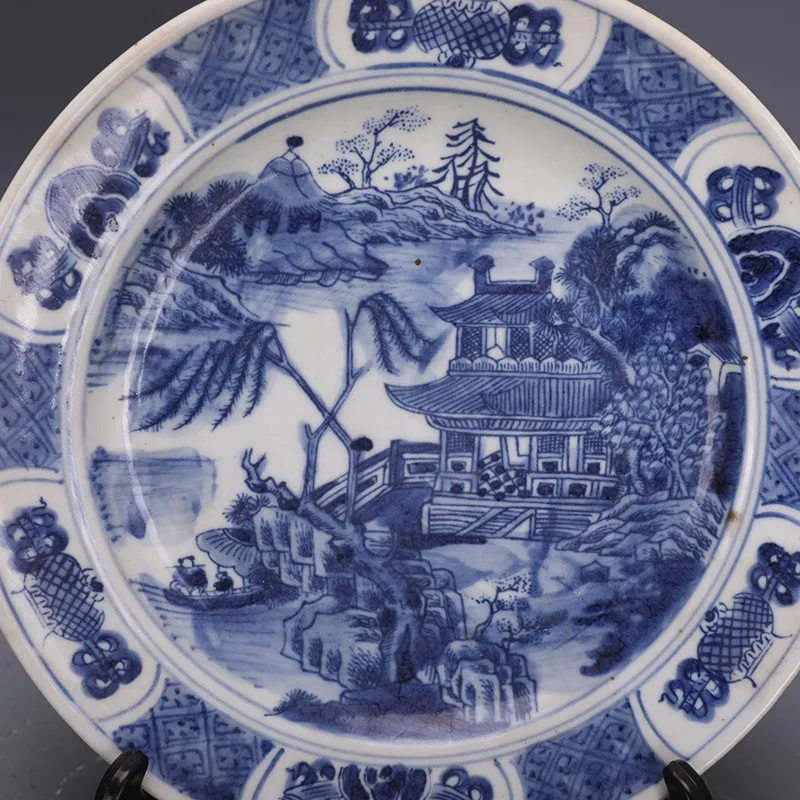
He begins with the pavilion. A small roof, a few pillars, a railing overlooking the water. It is a scholar's retreat, the place where a gentleman goes to escape the cares of the world.
Next, the willows. Their branches droop toward the lake, each leaf suggested with a single, swift brushstroke. Weeping willows-the tree of parting, of grace, of spring's return.
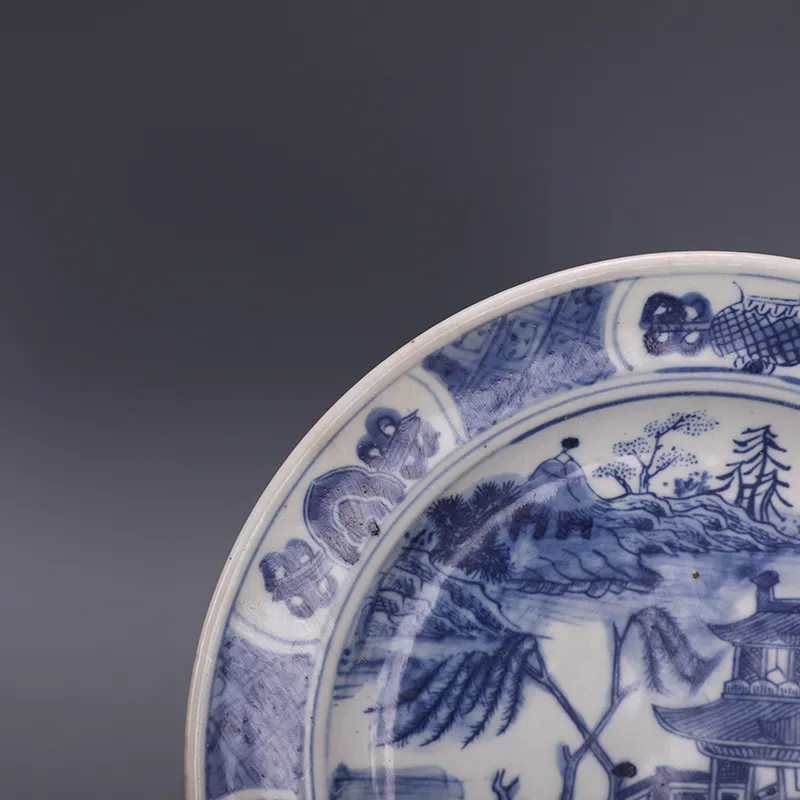
Then the mountains. Old Wu loads his brush with cobalt and washes it across the plate's surface. The brush is wet; the pigment bleeds into the glaze, creating soft, misty shapes that recede into the distance. This is fenshui-"water-division"-the technique that allows a single brush to paint five shades of blue.
Finally, the boat. A tiny skiff, a single figure at the bow, drifting across the empty water. No destination. No hurry. Just the slow, patient journey of a scholar returning to his studio.
Old Wu sets down his brush. He does not sign his name. He never does. He is not an artist; he is a craftsman. His work will be sold, shipped, used, and eventually discarded.
But he knows something that the wars and treaties cannot touch: a painted landscape can hold a moment of peace longer than any empire.
The plate did not stay in China. It was shipped to Europe, perhaps as ballast in a tea clipper, destined for a merchant's table in London or Liverpool. For decades, it served its purpose-holding food, being washed, being stacked. The landscape on its surface was admired, then ignored, then admired again.
In the 1970s, it was purchased by an English collector of Chinese export porcelain. He recognized the quality of the painting, the subtlety of the fenshui technique, the elegance of the composition. He placed it on a stand and displayed it on his sideboard.
When he died, the plate passed to his son, and then to Verity Antique.
Today, more than a century after Old Wu painted it, the plate remains flawless. No chips. No cracks. No restoration. The cobalt is as deep as the day it was fired.
The scholar still sits in his pavilion. The willow still weeps. The boat still drifts across an empty lake.

The Form: A Circular Canvas
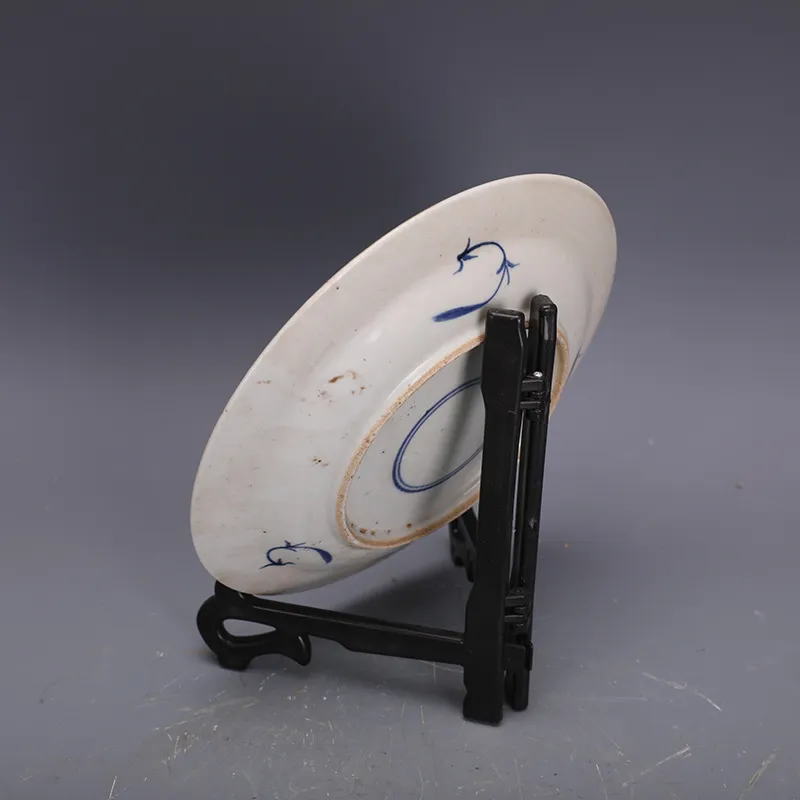
The plate is 21 cm in diameter-generous enough to serve as a charger for a whole fish or a festive roast, yet intimate enough to reward close inspection.
Height: approx. 3 cm-shallow, with a gently curving rim
Mouth diameter: 21 cm-a wide, circular canvas
Base diameter: 11 cm-stable, with an unglazed foot ring
Weight: approx. 800 g-substantial, satisfying
The form is practical: a serving plate, designed to be used. But the decoration transforms it into something more: a circular painting, a window into another world.
The Landscape: A Scholar's Retreat
The landscape motif on this plate is deeply rooted in Chinese scholarly tradition.
The Pavilion
A small roof, a few pillars, a railing overlooking the water. This is the ting-the scholar's retreat, the place where a gentleman goes to read, to write, to drink tea, and to escape the cares of the world. The pavilion suggests a life of cultivated leisure, of poetry and conversation, of the simple pleasures that make civilization worthwhile.
The Willows
Weeping willows droop toward the lake, their branches swaying in an imagined breeze. In Chinese culture, the willow (柳, liu) is the tree of parting-friends would break off a willow branch to give to a departing traveler. But the willow also represents grace, resilience, and the arrival of spring.
The Mountains
Layered in soft, misty blue, the distant mountains recede into the background. This is shanshui (山水), "mountain-water," the fundamental subject of Chinese landscape painting. The mountains represent the infinite, the unattainable ideal toward which the scholar aspires.
The Boat
A tiny skiff, a single figure at the bow, drifts across the empty water. The solitary boat (孤舟, guzhou) symbolizes the individual's journey through life-or the recluse's simple, virtuous existence, far from the corruption of the court.
Together, these elements create a complete world: a place of peace, of reflection, of harmony between humanity and nature.
The Technique: Fenshui, Water-Division
The fenshui (分水) technique is the signature of fine Chinese blue-and-white.
In ordinary blue-and-white painting, the cobalt pigment is applied in a single, uniform shade. The result is bold but flat-all foreground and background share the same intensity.
Fenshui changes this. The painter loads his brush with cobalt, then dilutes it with water to create different shades. A single brush can produce five distinct tones-from deep, dark blue to pale, misty lavender.
On this plate, the fenshui technique is used with exceptional skill:
| Area | Shade | Effect |
|---|---|---|
| Foreground rocks | Deep blue | Solid, close, present |
| Pavilion and willows | Medium blue | Clear, detailed, accessible |
| Distant mountains | Pale blue | Soft, misty, receding |
| Sky and water | Very pale blue | Atmospheric, open, infinite |
This variation in tone creates atmospheric perspective-the illusion of depth on a flat surface. The eye moves naturally from the dark foreground to the light background, as if looking through a window into a real landscape.
The Border: A Frame for Nature
The border decoration is not an afterthought. It is a deliberate frame.
The rim is divided into kaiguang (开光) panels-"reserved panels" that alternate between floral and geometric motifs. The panels are structured, rhythmic, orderly.
This creates a classic tension in Chinese design:
The landscape: free, organic, natural, infinite
The border: structured, man-made, finite, controlled
Together, they suggest the harmony between humanity and nature-the ordering hand of civilization placed around the wild beauty of the natural world.
The Context: Literati Taste for a Wider World
In the Qing dynasty, porcelain was not only for the court.
By the Guangxu period (1875–1908), the merchant and middle classes had grown wealthy and sophisticated. They wanted to surround themselves with objects that reflected cultivated taste-even if they could not afford the finest imperial wares.
This plate represents that democratization of beauty. It was made for a household that valued scholarly ideals: the retreat pavilion, the solitary boat, the distant mountains. It could be used for serving food, then admired as a painting, then used again.
The scholar's studio had expanded to include the dining table.
Rarity and Condition
Large blue-and-white plates of the Guangxu period are not rare. But plates of this quality-with flawless fenshui painting, a complete and balanced composition, and perfect preservation-are uncommon.
This plate is exceptional:
No damage: No chips, no cracks, no scratches
No restoration: The glaze is original and undisturbed
Vibrant cobalt: The fenshui shading remains crisp and clear
Perfect firing: No warping, no kiln flaws
After more than a century of use-and then display-it remains as Old Wu painted it.
Use and Ambiance
Ideal for: serving | display | the scholar's table
As a serving piece
Its substantial size makes it perfect for presenting a whole fish, a festive roast, or an artful array of appetizers. The landscape will be partially covered by food, then revealed as the meal progresses-a reminder of beauty even in the midst of daily life.
As a display piece
When not in use, position it on a plate stand on a sideboard, buffet, or mantelpiece. The circular landscape becomes a "painting" that reveals new details as you move around it.
As a scholar's object
In a study, tea room, or dining room with a traditional aesthetic, this plate adds a layer of cultural depth and quiet elegance. It encourages diners to pause between courses and appreciate its serene beauty.
Care Instructions
| Task | Method |
|---|---|
| Handling | Support with both hands, one under the base, one on the rim. |
| Cleaning | Hand wash with mild soap and lukewarm water. Dry immediately. Do not use a dishwasher. |
| Display | Avoid direct sunlight, which can fade cobalt over time. |
| Storage | Stack with soft separators between plates. |
Specifications
| Attribute | Details |
|---|---|
| Period | Qing Dynasty, Guangxu Period (1875–1908) |
| Material | Porcelain with underglaze cobalt blue |
| Dimensions | Height: 3 cm; Mouth: 21 cm; Base: 11 cm |
| Weight | Approx. 800 g |
| Form | Serving plate / charger |
| Primary Technique | Fenshui (water-division) blue-and-white painting |
| Primary Motif | Jiangnan landscape with pavilion, willows, boat, and distant mountains |
| Border Decoration | Patterned kaiguang border with floral and geometric motifs |
| Condition | Excellent; flawless glaze; no restoration |
| Provenance | Jingdezhen → English collection (1970s) → Verity Antique |
You May Also Enjoy
Interlocking Lotus Willow-Leaf Vase / Wanli Period
Double Lion Wucai Porcelain Cup / Ming Dynasty
Inquire Now
Price: $1,900 USD
For detailed condition reports, additional photographs, or to arrange a private viewing, please contact us directly.
To hold this plate is to hold a moment of peace painted in cobalt. To use it is to continue a tradition that began in a Jingdezhen workshop, more than a century ago.
This genuine Qing Dynasty Guangxu period blue and white landscape plate is available exclusively through Verity Antique.