

Yue Ware Tea-Dust Glaze Zoomorphic Ewer: Where Myth Meets Function
Mar 27, 2026
Leave a message
The Story
In the seventh year of the Zhenguan era-634 by Western reckoning-a Persian merchant named Roxana arrived in Chang'an.
She had traveled the Silk Road for eight months, her caravans laden with spices, glassware, and metal ewers of Sassanian design. She had heard of the Tang capital's wonders, but nothing prepared her for the city's scale, its cosmopolitan energy, its appetite for the new.
On her second day, a Tang official invited her to his home. The meal was lavish, the wine abundant. When the servants brought the ewers, Roxana stopped mid-sentence.
One ewer was unlike any she had seen in Persia or China. Its body was rounded, generous. A rooster's head formed the spout, its beak open as if to greet the dawn. A dragon arched across the top, its sinuous body forming the handle, its head resting near the rim as though watching over the wine within.
"The rooster announces the light," the official said, following her gaze. "The dragon commands the waters. Together, they ensure the wine is never dark and never runs dry."
Roxana smiled. "In Persia, we also put animals on our vessels. But never two such different creatures on one."
The official lifted the ewer, poured wine into her cup. "The Tang," he said, "is where different creatures learn to share the same vessel."


The Vessel: A Dialogue of Creatures
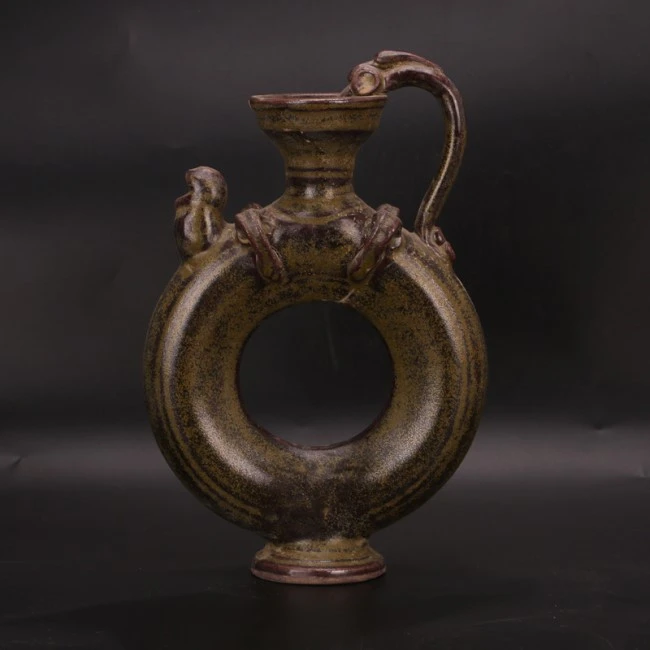
This ewer, standing 24 cm in height with a body diameter of 15.5 cm, is a masterpiece of Tang zoomorphic imagination.
The chicken-head spout is a beloved motif that appears across Tang ceramics. The rooster is a solar symbol-the creature that announces dawn, that dispels darkness, that calls the world to wakefulness. In Daoist thought, the rooster also wards off evil spirits, its crowing scattering the forces of night.
But this is not merely symbolic. The rooster's head is rendered with keen observation: the comb, the wattles, the alert eye, the beak slightly open as if mid-crow. The artisan understood chickens not as abstractions but as living creatures.
The dragon handle provides counterpoint. Where the rooster is terrestrial, the dragon is celestial. Where the rooster announces the day, the dragon commands the rain. The dragon's sinuous body arches with controlled energy, its head resting near the rim, its gaze following the pour.
Together, they create what the Tang poet Li Bai might have called a "harmony of opposites"-yang and yin, earth and sky, the everyday and the divine, sharing one vessel.
The Glaze: Tea-Dust Magic
The tea-dust glaze is a technical achievement that marks a significant evolution in Yue ware tradition.
Earlier Yue celadons were translucent, their green glaze revealing the body beneath. But this ewer is cloaked in something different: an opaque, speckled brown-green surface that resembles tea leaves ground to powder and scattered across damp earth.
The effect is achieved through iron oxide crystallization under precise firing conditions. The glaze is not applied but grown-the iron particles forming crystals as they cool, creating a surface that is simultaneously smooth and textured, uniform and varied.
Under light, the glaze shimmers with subtle variation. The brown deepens in shadow, the green catches the light, the iron crystals glitter like mica in river sand. It is the color of aged bronze, of autumn fields, of tea brewed strong and left to cool.
The Tradition: Yue Kilns and the Invention of Celadon
Yue ware represents one of the oldest continuous ceramic traditions in China. For over a thousand years, the kilns of northern Zhejiang produced wares that were prized across Asia.
By the Tang dynasty, Yue celadon had achieved a status akin to jade. The poet Lu Guimeng wrote of Yue ware's "thousand peaks of emerald color"-a reference to the way the glaze seemed to capture the green of distant mountains.
This ewer belongs to a later moment in the Yue tradition, when the translucent green of the classic period gave way to the opaque, textured surfaces of the late Tang and early Song. The tea-dust glaze represents a departure-a move away from the refinement of the early period toward something earthier, more textured, more willing to embrace the accidental.
The Cosmopolitan Tang
This ewer could only have been made in the Tang dynasty.
The Tang was an era of unprecedented cultural exchange. The Silk Road brought Persian metalwork, Central Asian motifs, Indian Buddhist imagery, and Sogdian merchants to Chang'an. The Tang appetite for the exotic was insatiable.
The zoomorphic ewer form itself shows foreign influence. Persian and Sogdian metalworkers had long produced animal-headed vessels. But the Tang potter transformed the foreign form into something distinctly Chinese: the rooster, a native symbol; the dragon, an imperial emblem; the rounded body, a Chinese interpretation of abundance.
This is the Tang achievement: not the rejection of foreign influence but its absorption, its transformation, its elevation into something new.
From Wine to Art
This ewer was originally made to hold wine or water-a functional vessel for a Tang table, perhaps the table of an official like the one who entertained Roxana.
But something happened on its journey through time. It became too precious to use. The glaze aged, the crystalline surface deepened, the rooster and dragon acquired the weight of centuries. At some point-perhaps in the Song dynasty, when Yue ware became prized by collectors-it ceased to be a vessel and became art.
It is now a sculpture, a conversation piece, a document of Tang cosmopolitanism. It should never hold liquid again. Its function is no longer to pour but to be contemplated.
Condition and Provenance
Condition: Exceptional. The rooster-head spout is intact. The dragon handle is complete. The glaze surface retains its full crystalline development. No restoration.
Provenance:
Mid-20th century: Distinguished European private collection
Present: Verity Antique
Display and Appreciation
Place this ewer where it can be seen from all angles. Its asymmetrical silhouette creates different profiles with each shift of perspective.
Under warm directional light, the tea-dust glaze shimmers. The iron crystals catch the light; the brown and green separate and merge; the rooster's eye seems to glint.
In a study or library, it adds immediate historical depth. In a modern interior, its earthy texture and organic form provide contrast. For the serious collector, it represents a key typology-a bridge between the early celadons of the Six Dynasties and the refined wares of the Song.
Specifications
| Attribute | Details |
|---|---|
| Period | Tang Dynasty (618–907) / Song Dynasty transitional |
| Material | Yue ware: high-fired porcellaneous stoneware with tea-dust glaze |
| Glaze | Speckled brown-green iron-oxide glaze; crystalline formation |
| Dimensions | Height: 24 cm; Body Diameter: 15.5 cm |
| Zoomorphic Features | Chicken-head spout; dragon-form handle |
| Form | Rounded-belly ewer |
| Original Function | Wine or water vessel |
| Current Function | Decorative art sculpture; collectible masterpiece |
| Condition | Exceptional; intact appendages; no restoration |
| Provenance | European private collection (mid-20th c.) → Verity Antique |
Conclusion
In 634, a Persian merchant in Chang'an admired a vessel that brought together a rooster and a dragon. She understood, perhaps, what the Tang official was telling her: that the Tang was a place where different creatures could share the same vessel, where foreign and native, earth and sky, function and myth could coexist.
That vessel has survived nearly fourteen centuries. It has outlasted the dynasty that made it, the table it graced, the wine it poured. It carries now the weight of its own history-the tea-dust glaze, the rooster's alert gaze, the dragon's sinuous arch.
It waits for the next hand, the next eye, the next moment of recognition.
Inquire now, and bring a Tang conversation into your home.
This genuine Tang/Yue ware zoomorphic ewer is available exclusively through Verity Antique. For inquiries, detailed condition reports, or to arrange viewing, please contact us.