

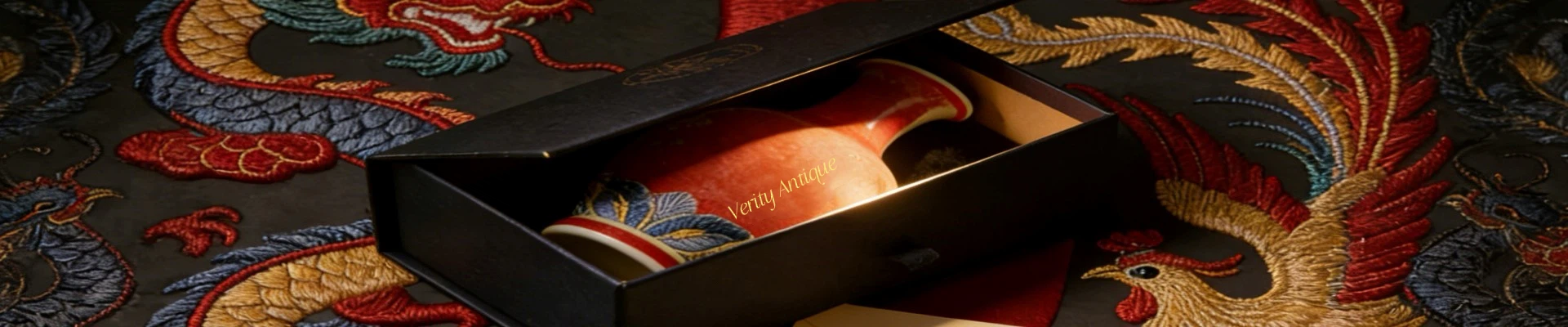
Red Glaze Mini Meiping: The Color of Celebration, The Form of Resilience
Jun 10, 2026
Leave a message
The Story
The year is 1736. The Qianlong Emperor has just ascended the throne, and the imperial kilns at Jingdezhen are humming with activity.
But this story does not begin with an emperor. It begins with a kiln master named Deng.
Deng was sixty-one years old when he received the commission. His hands had been shaping clay since he was a boy of twelve. He had lived through the Yongzheng reign, when the imperial kilns produced some of the finest monochrome glazes in Chinese history. He knew the secrets of the fire.
The commission was for a single vase.
Not a large one-just 16.7 cm tall, with a slender neck swelling into a rounded belly, then tapering to a small foot. The meiping form, the "plum vase," designed to hold a single branch of winter blossom.
But the glaze was the challenge.
Copper-red.
The color of celebration. The color of weddings and New Year festivals. The color of good fortune, joy, and life-giving fire. The color that, in the spiritual cosmology of China, corresponds to the south, to summer, to the phoenix itself.
Copper-red was also the most difficult glaze in all of ceramic history.
The pigment was copper oxide. Applied to the porcelain body, it fired to a dull green. Only in a reduction atmosphere-a kiln starved of oxygen-would the copper transform, its molecules rearranging themselves into the deep, luminous red that the court demanded.
But the transformation was fickle. Too little reduction, and the red remained green. Too much, and it turned grey. The temperature had to be precise-within a few degrees. The timing had to be exact. And the kiln, a temperamental beast of brick and fire, did not always obey.
Deng had prepared the clay body. He had mixed the glaze-copper oxide ground to a fine powder, suspended in a feldspathic base. He had dipped the vase, covering it in a thin, even coat.
Then he placed it in the kiln.
He lit the fire.
The night was long. Deng did not sleep. He watched the flames through the small peephole, adjusting the air intake, feeding wood when the temperature dropped, praying to the god of kilns when the fire ran hot.
At dawn, the kiln master gave the signal. The fire was extinguished. The cooling began.
Deng waited.
When the kiln was cool enough to open, he reached in with iron tongs and pulled out the vase.
The red was perfect.
Deep, luminous, vibrant-like a drop of imperial seal paste, like the sun rising over the Forbidden City, like the moment when fire finally submits to human will.
The surface was flawless. No pinholes, no crawling, no grey patches. Just pure, unbroken red, from the narrow mouth to the small foot.
Deng held the vase in his hands. It was warm still.
He did not know that it would outlast him. That it would outlast the Qianlong Emperor, the Qing dynasty, the fall of the empire, the rise of the republic. That it would travel from his kiln to the Forbidden City, to a European collection, to a dealer's cabinet, to a collector's shelf across the sea.
He only knew that, for one morning, the fire had listened.


The Form: Meiping, the Plum Vase
The meiping (梅瓶) form is one of the oldest and most celebrated shapes in Chinese ceramics.
Its name means "plum vase." The narrow neck was designed to hold a single branch of winter plum blossom, while the swelling body provided space for water or wine. The plum blooms in the cold, its flowers appearing while snow still lies on the ground. For the scholar, the plum was a metaphor for the cultivated gentleman: virtuous even in adversity, beautiful even in hardship.
On this vase, the meiping form is rendered at a miniature scale:
Height: 16.7 cm-small enough to hold in one hand
Belly diameter: 6.9 cm-full, generous, perfectly proportioned
Mouth: narrow, delicate-designed for a single stem
Foot: small, stable-grounding the form
The proportions are those of the Qing ideal: balanced, harmonious, confident. The vase swells at the shoulder, then tapers gently to the base. The curve is continuous, unbroken, like the arc of a rising sun.
This is a form that demands nothing but itself. No decoration, no carving, no painting. Just pure, sculptural presence.
The Glaze: Copper-Red, the Emperor's Color
The copper-red glaze is the soul of this vase.
Its history is a story of ambition and loss. Copper-red was first perfected in the Yuan dynasty, then flourished in the early Ming, during the Xuande reign (1426–1435). But the technique was difficult, the failures many, and by the late Ming, the secret had been lost.
The Qing dynasty revived it. Under the Kangxi, Yongzheng, and Qianlong emperors, the imperial kilns at Jingdezhen mastered copper-red once again, producing monochrome glazes of unparalleled depth and purity.
The chemistry is simple in theory:
Copper oxide provides the color
Reduction firing (starving the kiln of oxygen) transforms the copper from green to red
Precise temperature control (within a few degrees) determines the final shade
But in practice, copper-red was a gamble. Countless vessels were lost in the firing for every one that succeeded. The kiln master could not know until the kiln cooled whether the red had "caught."
On this vase, the red is flawless. Deep, luminous, vibrant-with the characteristic warmth of the finest Qing copper-red. Under light, it seems to glow from within, like a coal just beginning to catch fire.
The Color: Auspicious, Imperial, Sacred
Red is the most auspicious color in Chinese culture.
It is the color of:
Celebration: Weddings, New Year, festivals
Good fortune: Happiness, prosperity, success
Life-giving fire: Warmth, energy, transformation
The phoenix: The south, summer, the empress
In the imperial context, red carried additional weight. The emperor's seal paste was red. The walls of the Forbidden City were red. The sacrificial vessels used at the Altar of Earth were red.
A flawless red glaze was a statement of imperial power-a declaration that the court commanded not only the resources of the empire but the secrets of the kiln.
The Miniature Scale: Intimacy and Power
This vase is small-just 16.7 cm tall.
But its small size is not a limitation. It is a choice.
The miniature scale invites intimacy. This is not a vase for a grand hall or a museum case. It is a vase to be held, to be turned in the hands, to be placed on a scholar's desk or a tea tray.
The small size also makes the technical achievement more remarkable. A small vase is more difficult to throw on the wheel than a large one. The walls must be thin, the proportions precise, the glaze even.
This vase is perfectly proportioned. The swelling belly, the narrow neck, the stable foot-all are rendered with the precision of a master potter.
Rarity and Condition
Red-glazed meiping of the Qing dynasty are not common. But miniature examples of this quality-with flawless copper-red glaze, perfect meiping form, and exceptional preservation-are rare.
Most red-glazed wares have some flaw: a pinhole, a patch of grey, a slight crawling at the foot.
This vase is flawless.
The glaze is even and unbroken. The surface is smooth and luminous. The form is perfectly preserved. There is no restoration.
Use and Ambiance
Ideal for: scholar's desk | tea room | collector's cabinet | windowsill
As a desk object
Place it on a small rosewood stand, next to a brush pot and an inkstone. Let it hold a single dried branch-or nothing at all. Its vibrant red provides a punctuation of color, a moment of warmth in a quiet room.
As a tea room accent
In a tea room, its red glaze complements the earthy tones of teaware and the green of bamboo. It is a reminder of celebration, of joy, of the fire that transforms leaf into tea.
As a collector's treasure
For the serious collector of Qing monochrome wares, this vase represents a perfect example of the form: well-potted, flawlessly glazed, and rich in symbolic meaning.
Care Instructions
| Task | Method |
|---|---|
| Handling | Hold by the base. The high-gloss surface shows fingerprints. |
| Cleaning | Dust with a soft, dry, lint-free cloth. Avoid liquids and abrasives. |
| Display | Avoid prolonged direct sunlight. |
| Preservation | The interior is glazed, but the vase is designed as a decorative object. Avoid using as a permanent vase for water. |
Specifications
| Attribute | Details |
|---|---|
| Period | Qing Dynasty, 18th–19th century |
| Material | Imperial porcelain with copper-red monochrome glaze |
| Dimensions | Height: 16.7 cm; Belly diameter: 6.9 cm |
| Form | Meiping (plum vase) |
| Glaze | High-temperature copper-red monochrome; deep, luminous finish |
| Condition | Exceptional; pristine glaze surface; no restoration |
| Provenance | European private collection → Verity Antique |
You May Also Enjoy
Red Glaze Mini Meiping (this piece)
Qing Ge Glaze Bamboo-Neck Gallbladder Vase / Qing Dynasty
Song Ru Celadon Gallbladder Vase / Song Dynasty
Inquire Now
Only one vase is available. The fire listened once. It will not listen again.
Price: $48,000 USD
For detailed condition reports, additional photographs, or to arrange a private viewing, please contact us directly.
To hold this vase is to hold a moment when fire and clay achieved perfection. To display it is to become the next steward of an emperor's treasure.
This genuine Qing Dynasty imperial red glaze mini meiping is available exclusively through Verity Antique.